Contributions to the Legislative Debate on Data Centers in Brazil
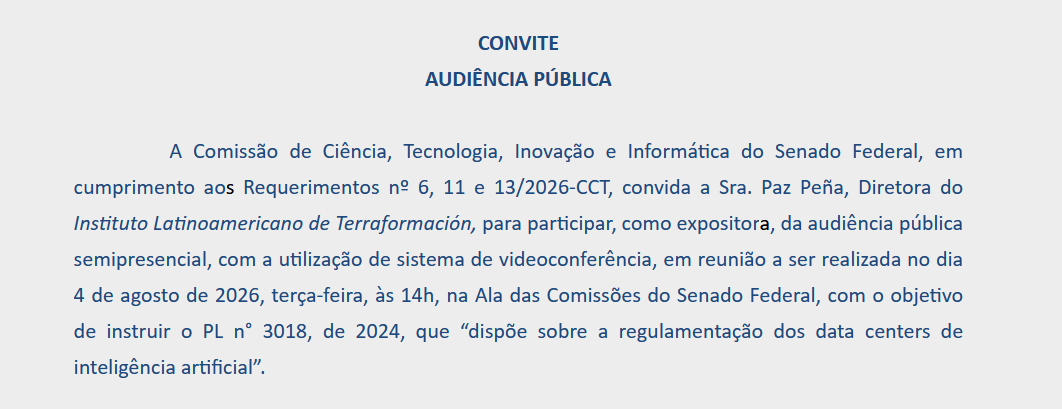
The Latin American Institute of Terraforming was invited to participate in a public hearing before the Committee on Science, Technology, Innovation, and Information Technology of the Brazilian Federal Senate to discuss Bill No. 3018 of 2024, which regulates the operations of artificial intelligence data centers.
During the session, we began by reviewing the diverse, growing, and as-yet-unknown socio-environmental impacts of data centers. We therefore demonstrated that the precautionary principle—as a rule for environmental protection and public health—appears to be the appropriate public policy for addressing the growing and as yet unknown impacts of this infrastructure.
We then provided an overview of Latin America, which led us to conclude that: governments across the continent have a debt to settle regarding the sustainability of AI; self-regulation does not work for the sustainability of data centers; and the challenge requires specific regulatory frameworks with clear conditions.
Likewise, in reviewing the Chilean case, we conveyed to the Senate that, due to the lack of clear legal safeguards governing the socio-environmental impacts of this infrastructure, data center projects in Chile often end up in court, which entails significant capital costs and uncertainty for both companies and affected communities.
This may serve as a useful lesson for Brazil, showing that the lack of adequate legal frameworks and public policies has delayed plans to develop this infrastructure, and that such infrastructure cannot be developed without involving communities throughout the environmental assessment process.
Among our suggestions for Bill 3018/2024 are:
Strategic and participatory socio-environmental planning as a role of the State: Above all, to avoid what is happening in the United States, where states compete aggressively to attract hyperscale data centers and decisions are shifted from public forums to private agreements and executive orders. This model privatizes benefits and control while socializing economic risks and environmental damage. It also undermines democratic accountability and resilience in the face of ecological limits (Kollar, J., 2026).
Requirement to undergo participatory and territory-specific environmental licensing procedures.
Requirements for metrics and accountability mechanisms regarding socio-environmental impacts.
Ensure mechanisms for energy justice.
Not losing sight of fundamental issues for public policy, such as the low social value of AI among populations like that of the United States, the minimal employment impact of data centers, and the risks of an economic and financial AI bubble—all of which leave open the question of how Brazil should legislate to address these dangers and shield its economy and population.
You can read our full statement at this link.