Socio-environmental Impacts of AI: It’s Not About Efficiency, but Politics
Article written for “Pensamiento Iberoamericano,” a journal published by the Ibero-American General Secretariat. This issue is dedicated to the upcoming 30th Ibero-American Summit of Heads of State and Government, to be held in Madrid on November 4 and 5, 2026, under the theme “Ibero-America. Together we build our Community. Together we project it toward the future and toward the world.”
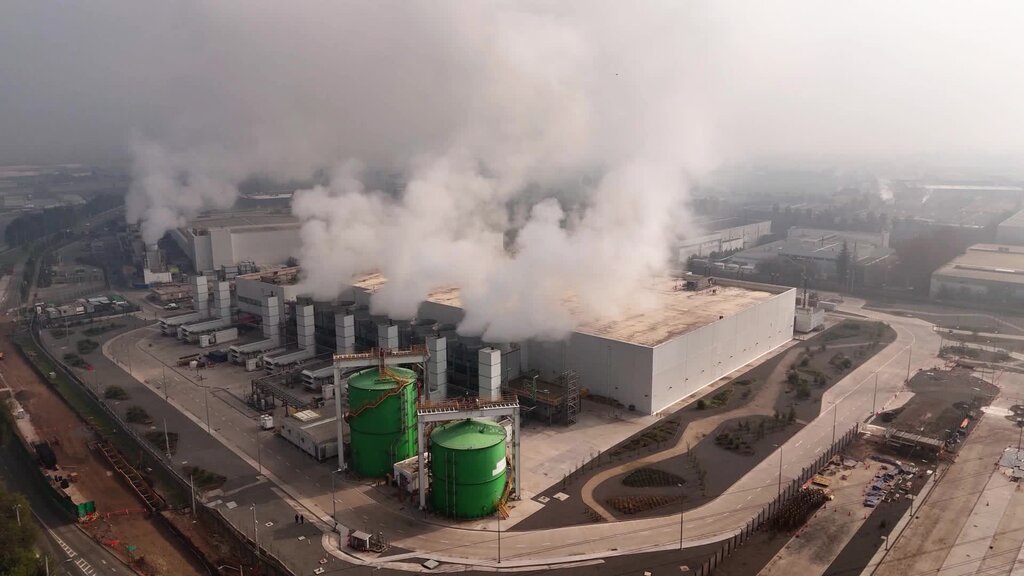 Photo: The New York Times – Water vapor rising from cooling towers at Google’s data center in Santiago, Chile
By Paz Peña, coordinator of the Latin American Institute of Terraforming.
[Spanish version / Portuguese version].
The growing socio-environmental impacts of Artificial Intelligence (AI) are not a matter of efficiency or will; they are the result of an economic and political model centered on a handful of very powerful companies determined to consolidate their power networks and reshape the global economic infrastructure in their favor.
In this context, the question is: what role do Ibero-American governments play, especially when it seems that we are viewed merely as a means of socializing the environmental costs of the AI economy? Amid a turbulent geopolitical landscape in which hegemonic power in the 21st Century will indeed be up for grabs, our countries can find a way forward through strategy, creativity, and solidarity.
An Inconvenient Truth
It’s not a matter of merit; it’s the design of the model: the frenzy surrounding AI is sustained by a narrative of technological determinism and inevitability that presents it as the only possible future, driving governments and investors to fund projects out of fear of being left behind. This is the case in several countries in Ibero-America, which are investing despite having no chance of competing on equal footing: cutting-edge AI depends on specialized chips, intellectual property, and hyperscale data centers concentrated among a small number of external providers. The concentration of resources determines who gains the strategic and economic advantages and who sets the terms for access, pricing, and data governance, widening the gap between creator and consumer nations.
The case of Latam-GPT reflects this situation: although it was presented as a model developed by and for Latin America to strengthen digital sovereignty, it uses Meta’s architecture and is trained on Amazon’s infrastructure. This demonstrates that sovereignty and the ability to compete do not depend solely on model development but also on control over digital infrastructure, data, energy, and the rules that underpin these systems.
This frenzy is designed, on the one hand, to fuel an economic bubble that allows loss-making AI companies to attract venture capital (such as OpenAI, which loses three times as much as it earns), while diverting attention from debates about existential risks or socio-environmental impacts. On the other hand, mass consumption facilitates what Cory Doctorow calls “shittification,” in which platforms first make themselves indispensable to capture users, then aggressively extract value and consolidate their dominance.
The Socio-Environmental Costs of the Model
This AI-frenzy model requires the global expansion of its data centers. Large corporations use this investment to fortify their dominant position and pursue a reverse business model, incurring billions in operating losses while forcing users and smaller competitors into cognitive and infrastructural dependence. This expansion is the material and political foundation that ensures power remains concentrated in an elite capable of sustaining this financial endurance race.
Furthermore, corporations need to plan for a more diverse and strategic distribution of data centers to meet the training and inference needs of models, which require characteristics such as low latency and efficient access to energy, water, and land. This explains why Brazil is home to one-third of Latin America’s data centers, while Chile and Mexico are establishing themselves as emerging markets: their governments offer policy measures to facilitate access to critical resources, including operating within socio-environmental legal loopholes. This loophole allows corporate profits to be privatized while environmental costs are socialized onto local communities and public budgets, in a context of zero public participation, a lack of transparency, and the classification of resource consumption, such as water, as a trade secret.
When discussing their range of socio-environmental impacts, water and energy are key issues. A hyperscale data center can consume up to 19 million liters of water per day for cooling—equivalent to the water use of a city of 50,000 people—a critical issue in regions experiencing water stress. Furthermore, a single AI query requires up to 10 times as much energy as a traditional search. The electricity consumption of data centers in 2025 (448 TWh) could meet the annual household energy needs of the entire population of sub-Saharan Africa for 2.6 years. This overwhelms local grids, has driven up electricity prices for consumers in the United States, and forces a reliance on fossil-fuel power plants to ensure supply.
In this context, some Latin American countries with cleaner energy mixes appear to be attractive destinations; however, this advantage is misleading: large-scale infrastructure is being attracted without a sufficient assessment of its cumulative impacts on energy systems, nor is there any political accountability regarding the power granted to these corporations in our countries’ energy transition.
A Socio-Environmental Policy for AI
Until now, the corporate narrative has been that AI sustainability will be achieved primarily through process efficiency. However, the Jevons Paradox demonstrates that improvements in technological efficiency often lead to an increase in total resource consumption. And while technical improvements exist to reduce environmental impact, they are isolated measures not replicated globally and do little to address the system’s scaling up.
In this context, a socio-environmental policy on AI from Ibero-America should not focus so much on mere efficiency measures or on implementing serious, transparent, and participatory legal frameworks—which, while necessary, are insufficient. A serious socio-environmental policy for AI in Ibero-America must be a digital economic policy that decouples itself from the frenzy surrounding AI and seeks new avenues for economic, human, and environmental sustainability through technological alternatives. This can only be achieved at the regional level, through multilateral dialogue, creativity, and determination. Perhaps this turbulent 21st century, rather than merely a crisis of hegemonies, is also an opportunity for our countries.